I don’t remember the exact moment burnout began.
There were no flashing lights. No grand announcement. It wasn’t dramatic. It just… crept in. Quietly. Like fog rolling in overnight. One day, everything felt harder than it should—but I couldn’t explain why.
In healthcare, we don’t really talk about burnout. Not seriously, anyway. We laugh about it in the break room. Shrug it off. Make dark jokes to survive the shifts. It’s worn like a weird badge of honour. A sign you’re working hard enough. Caring enough.
But it’s not just being a bit tired. It’s not just a rough patch.
It’s an occupational hazard. And honestly, now I know the signs… I see it everywhere.
What Burnout Actually Is
It’s more than stress. Burnout is a full-body shutdown—emotional, physical, mental exhaustion that builds from doing too much, too often, for too long.
The ones who burn out aren’t lazy. They’re the ones who care the most. The ones who give the most. The ones who rest the least.
The World Health Organization defines burnout as a work-related syndrome with three main ingredients:
- Emotional exhaustion – You’re drained. You feel like you’ve got nothing left.
- De-personalisation – You go numb. You stop feeling anything about the people or the work.
- Reduced personal accomplishment – You wonder if anything you do even matters.
How It Creeps In
Burnout doesn’t knock. It doesn’t shout. It builds in stages:
| Stage 1: Enthusiasm | You’re lit up. You say yes to everything. You love being useful. |
| Stage 2: Stress creeps in | The cracks begin. You’re stretched, but you tell yourself it’s fine. Just a busy season. |
| Stage 3: Chronic stress | You start snapping. Sleeping badly. Drinking more coffee. Laughing about how dead inside you feel. |
| Stage 4: Burnout | You disconnect. You dread going in. You feel numb. Or worse—like you don’t care anymore. |
| Stage 5: Breakdown | You hit the wall. Or rather, the wall hits you. Your body. Your brain. Your heart. All say no more. |
Adapted from De Hert(2020)
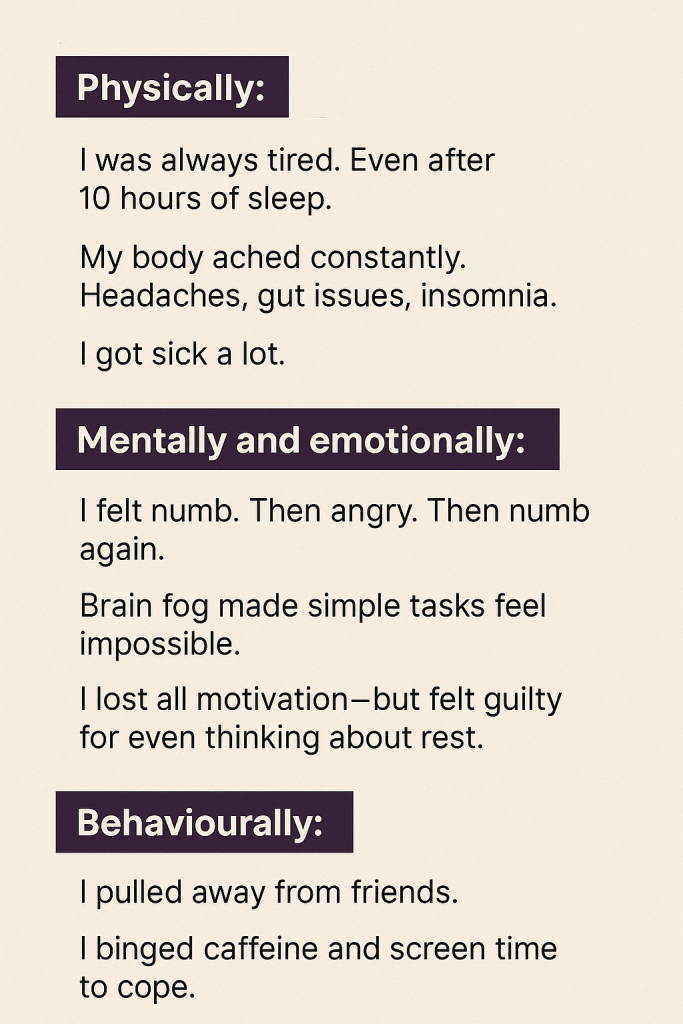
What It Feels Like (and What I Missed)
Looking back, the signs were there.
How to Spot It in Others (Because I Hid It Well)
Burnout rarely announces itself.
Most of us won’t say “I’m burning out.”
We’ll say “I’m just tired.”
We’ll smile. Show up. Say yes.
But there are signs if you know what to look for:
- The colleague who used to be bubbly but now barely talks.
- The person who’s always late or calling in sick.
- The over-apologiser.
- The one who’s always “fine,” even when they’re clearly not.
Sometimes the most burnt out are the ones keeping everything together.
So keep an eye on the strong ones. The smiley ones. The ones who never complain. Because burnout doesn’t always look like falling apart—it often looks like coping.
Until suddenly, it doesn’t.*
–Duty Of Care
*Head to our resources page to explore the range of information and support available – Resources

References:
De Hert S. Burnout in Healthcare Workers: Prevalence, Impact and Preventative Strategies. Local Reg Anesth. 2020 Oct 28;13:171-183. doi: 10.2147/LRA.S240564. PMID: 33149664; PMCID: PMC7604257.
 Duty of Care
Leave a comment